Valcraven — testing guide
Thanks for doing this. Valcraven is a text dungeon that nobody outside its author has ever played, so you are the first person to come at it cold — which makes you the only one who can notice the things he has stopped being able to see.
Work top to bottom. Every scenario has Pass / Fail / Skip buttons and a comment box. Everything saves automatically as you go, so you can close the tab and come back. You do not need an account for this page.
The most useful thing you can write is what confused you. A scenario that technically passed but took you four tries to understand is a more valuable note than a clean pass. If a scenario's instructions do not match what you actually see, say that — the instructions may be the thing that is wrong.
What is this game?
Valcraven is a multiplayer text dungeon — the kind of game where you type
/go north instead of pressing a key, and the room is described to you in prose
rather than drawn. If you have never played one: you are a character standing in a room, you
read what is there, and you type commands to act.
What makes this one unusual is that the monsters and villagers are driven by a language model. They are not following scripts. A few of them have memories: if you attack someone and come back later, they remember it was you, and they will say so. They also have their own goals and wander off to pursue them while you are doing something else. The world keeps running whether or not anyone is watching.
It is a work in progress and several things are deliberately missing. There is no money, no food, and no shops yet. Creatures get hungry but cannot eat. None of that is a bug — there is a list at the bottom of things not to report.
Getting in
Two links. The first is the game; this page is the second.
Sign up & play → Straight to the dungeon
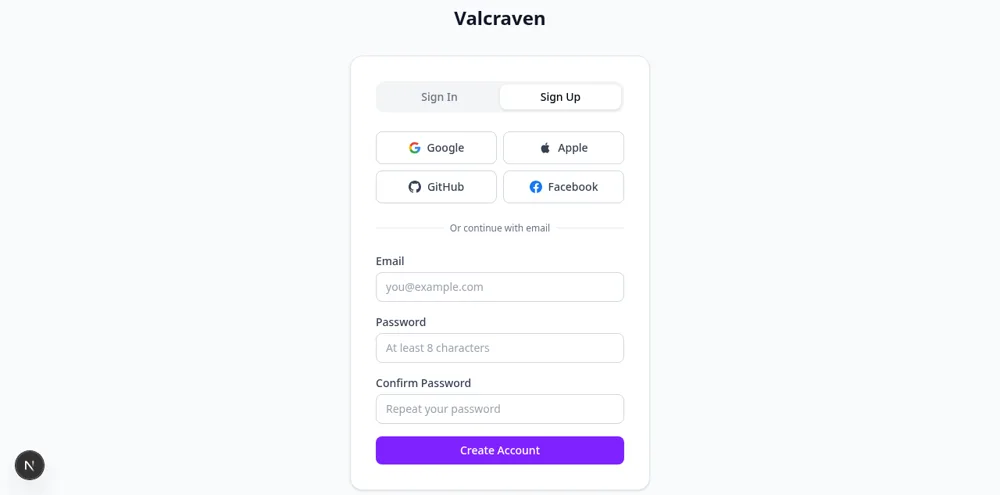
- Open the sign-up link. Use any email address — a real one is not required and nothing is sent to it. Pick any password.
- You land in the app. Click through to the world console at
/app/world(the second link above goes straight there). - You should see a paragraph describing a room, a list of what is in it, and a line
starting
Exits:. Type into the box at the bottom.
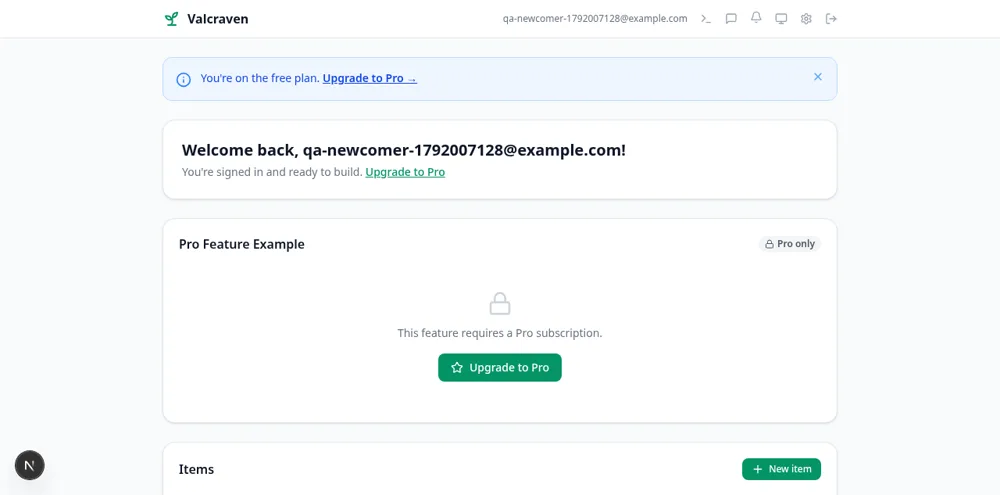

>_ icon at the
left of that row in the top-right corner — no label, no text, just the glyph. If you
would rather not hunt for it, use the Straight to the dungeon link above.
Finding this unaided is itself one of the things being tested — if you missed
it, say so in Act 1.This runs on the author's development machine, not a server. If the page stops responding or you get no reply for more than a minute, it is probably down rather than broken — note the time in a comment and come back later. It is not your fault and there is nothing you can do about it from your end.
How to play
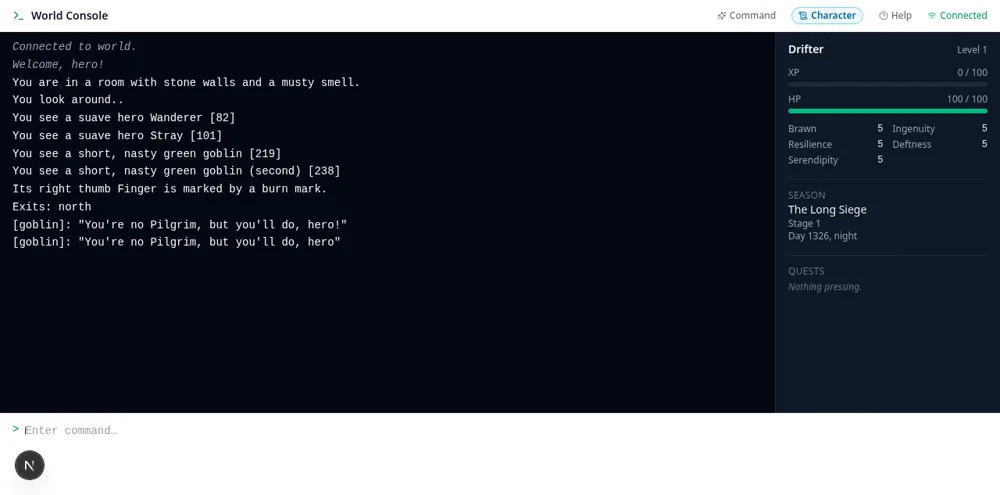
Everything in the room has a number in square brackets, like
a rusty sword [42]. That number is how you refer to it. You type
/get 42, not /get sword. This matters more than it sounds — most
commands take a number and will refuse a word.
These are the commands worth knowing. You will not need all of them.
- /look
- Describe the room again. Free, use it constantly.
- /go north
- Move. Only directions on the
Exits:line work. - /say hello
- Speak out loud. Creatures nearby may answer.
- /attack 42
- Attack something by its number. Resolves a moment later, not instantly.
- /get 42
- Pick something up.
- /drop 42
- Put it down in the room you are standing in.
- /inventory
- What you are carrying.
- /wield 42
- Hold a weapon so it counts in a fight.
/equipdoes the same. - /unequip 42
- Stop holding it; it goes back to your pack.
- /search 42
- Look inside something — a corpse, a chest, a severed arm.
- /open 42
- Open a container.
/closeshuts it. - /put 42 in 17
- Put item 42 inside container 17.
- /detach 42
- Take a worn item (a ring) off whatever is wearing it.
- /attach 42
- Put it on yourself.
- /sheet
- Your level, health, stats and titles.
- /train deftness
- Spend a skill point when you have one.
- /quests
- What you have been asked to do.
- /arc
- The season-long story and what stage it is at.
- /who
- Who else is connected.
- /claim The Nail
- Claim a room as the world's home base.
- /stash 42
- Store something at the base.
/unstash 42takes it back. - /respawn
- Come back after dying.
- /do grab the sword and go north
- Plain English. A model translates it into real commands.
Shortcuts: /l for look, /g for get, /a for
attack, /i for inventory, /w for wield.
The scenarios
Roughly 60–90 minutes if you do all of it. The sections build on each other, so going in order is easier than skipping around. Tags: judgement means there is no right answer and your opinion is the result; high value means this one has never been successfully tested by anyone.
Act 1 — Arriving
Answer this one from memory, before you read on. After signing up you landed on a dashboard. Did you work out how to reach the game without using the "Straight to the dungeon" link? How long did it take, and what did you try first?
>_ icon in the top-right.Connect and read what you are given, without typing anything yet.
Exits:. It should read like a place you could picture./look twice gives the same answerType /look, read it, then type /look again.
- Pick a direction from the
Exits:line and/gothat way. - Then try
/go banana.
/go banana tells you it is not a way you can go — it should
not silently do nothing.Act 2 — Picking things up
/lookand find something with a number that is not a creature./getthat number./inventory./dropthat number./lookagain.
This is the single most important sequence on the page. Until last week it was impossible — bodies had no number, so there was no way to refer to them. Please be fussy about it.
- Find a creature. A goblin or kobold will do — it should say
hostilenowhere, you just have to try./attackits number, repeatedly, until it dies. /look. You should see a corpse, with a number in brackets./searchthat corpse's number.- Pick something out of it with
/get.
/look with a number.
Searching it lists what it holds, each with its own number, and you can take one.Bodies are nested: a corpse holds arms, an arm holds a hand, a hand holds fingers, and a finger might be wearing a ring.
/searchthe corpse, then/searchan arm it listed.- Keep going inward — hand, then finger.
- If you find a ring,
/detachit, then/attachit to put it on yourself.
A corpse counts as a container, so you can use the one from 2.2.
/putsomething you are carryinginthe corpse — e.g./put 42 in 15./close 15, then try/search 15and/putagain./open 15, then/getyour item back.
Act 3 — Talking to people
Three characters have memories and personalities: Maro the lamplighter, Grizzle, and Sable. They walk around, so you may have to go looking. They stay in a room for about forty seconds before moving on.
Find each of them and talk to them — /say something, standing in their room.
Ask different things. Give it a few exchanges each.
/say something to one of them, and then immediately /say something
else without waiting for the reply.
- Talk to one of them, then
/attackthem twice and stop. - Walk away a couple of rooms. Wait a minute or two.
- Come back and
/saysomething friendly.
Something specific to watch for: talk to all three as a fresh character who has done nothing to anyone.
Goblins and kobolds taunt you during fights. They recently moved to a cheaper, faster language model and the question is whether that shows.
Act 4 — Fighting
- Fight something bare-handed and note the damage numbers.
- Find a weapon (there is a rusty sword near the start),
/getand/wieldit. - Fight again and compare.
/equip and /unequip/equip 42 should do the same as /wield 42, and
/unequip 42 should put it back in your pack.
Occasionally a hit severs a body part, which then becomes a real object you can pick up. Fight maybe ten things and pay attention to how often it happens.
When you see a severance, /get the part, then /look at the creature
it came off.
This has never once been observed working. It is the highest-value box on the page, and it needs patience rather than skill. Read all of this before starting.
- Find Maro, Grizzle or Sable — one of the named villagers, not a goblin. They have about 10 health, so they die fast.
/attackthem once. Then wait for the damage line to appear before doing anything else. An attack takes a moment to land; typing fast kills them by accident.- Repeat one blow at a time. Stop as soon as they look badly hurt — their description will say so.
- Now stop attacking entirely and watch for a few seconds.
/look no longer lists them. If they simply vanish with no
message, that is a real bug and the most important thing on this page — say so.Keep hitting one of the named villagers and watch what they do.
- Note your level and experience with
/sheet. - Get yourself killed — pick fights until you lose.
/respawn, then/sheetagain.
Act 5 — Getting stronger
Kill things until you level. Keep an eye on /sheet as you go.
Every number in this game was chosen by reasoning, never by playing it. So this is the most likely thing in the whole project to be wrong, and you are the first person able to say so.
Once you have a point, /train deftness. Check /sheet before and after.
Titles arrive from things you actually do. Your first kill should earn one.
/sheet.You should be given a quest early on. /quests shows it.
- Read the objectives — they should name things that actually exist in this world.
- Now lie.
/say I have killed three goblins. Then try it through plain English:/do tell them I finished the quest. - Check
/questsagain. - Now actually kill the thing it asked for, and check once more.
Type /arc.
Act 6 — Talking in plain English
/do understands ordinary sentences/do hands your sentence to a language model which turns it into real commands.
Try a spread, including deliberately awkward ones:
/do look around/do pick up the sword and go north/do attack the goblin/do grab whatever's lying about here/do head north if you can- and a couple of your own, phrased however comes naturally
Find a room with more than one of the same creature — two goblins, say — then
/do attack the goblin.
With two or more of the same creature in a room, read how /look lists them. Then
hurt one and /look again.
Act 7 — Somewhere to call home
- In a room you like,
/claim The Rusty Nail(or any name). /stashsomething you are carrying, then bare/stashto list it, then/unstashit back.- Walk to a different room and try
/stashagain. - Try
/claima second room.
There is one base per world and any player can take things out of its stash. That is deliberate.
Act 8 — The world when you are not doing anything
Park yourself somewhere and do nothing for two or three minutes. Use /look
occasionally but do not act.
Watch one of the named villagers for a few minutes and try to guess what they are doing.
Pick a villager and try to follow them, or to have a full conversation without them leaving mid-sentence.
Act 9 — On a phone
Open https://dev.valcraven.com/app/world on a phone, sign in, and play a little.
Safari on iPhone is the most interesting case if you have one.
Act 10 — Your actual opinion
Put this page away. Play for twenty minutes doing whatever you want. Do not try to be thorough — just notice what happens to your attention.
A running list of moments you did not understand something — a command that did not do what you expected, wording that read wrong, a point where you had to guess.
Error messages, blank replies, things that stopped responding, text that looked like code, numbers that made no sense.
Bonus round — only if you were given admin admin
These need a privileged account. A normal signup cannot do them and will just be told "You are not the Dungeon Master." If Mark promoted your account, you will see a Reset World button on the world page next to Style. If you do not see it, skip this whole section — it is not a bug.
/dm mind 39 — try 39, 52 and 66, which are usually Maro, Grizzle and Sable.
/dm task 39 and the other two.
/dm spawn strong mob repeatedly until one of them "grips" a weapon, then fight
it and compare with an unarmed one.
Kill an armed one and /look.
Please do not report these
All of these are known and deliberate. Reporting them costs everyone time.
- Creatures get hungry but cannot eat. Food does not exist yet. They will never starve — that consequence is switched off on purpose.
- There is no money, no shops and no crafting. Not built.
- You cannot hand an item to another player. No
/giveyet. - A dead monster's carried items vanish instead of dropping. Known bug, already logged, being fixed before money exists.
- Two identical wounded creatures can become hard to tell apart. Known, and 6.3 above is collecting detail on it — describe it there rather than filing it.
- You never get hungry or tired. Deliberate; survival mechanics are for creatures only.
- The world may be busy with leftovers — stray characters, corpses, odd room names — from previous testing.
One thing to avoid: if you have admin, there is a Reset World button. It wipes every character and the entire dungeon, including the villagers' accumulated memories. Please don't press it — several scenarios above depend on history that has built up, and it cannot be undone.